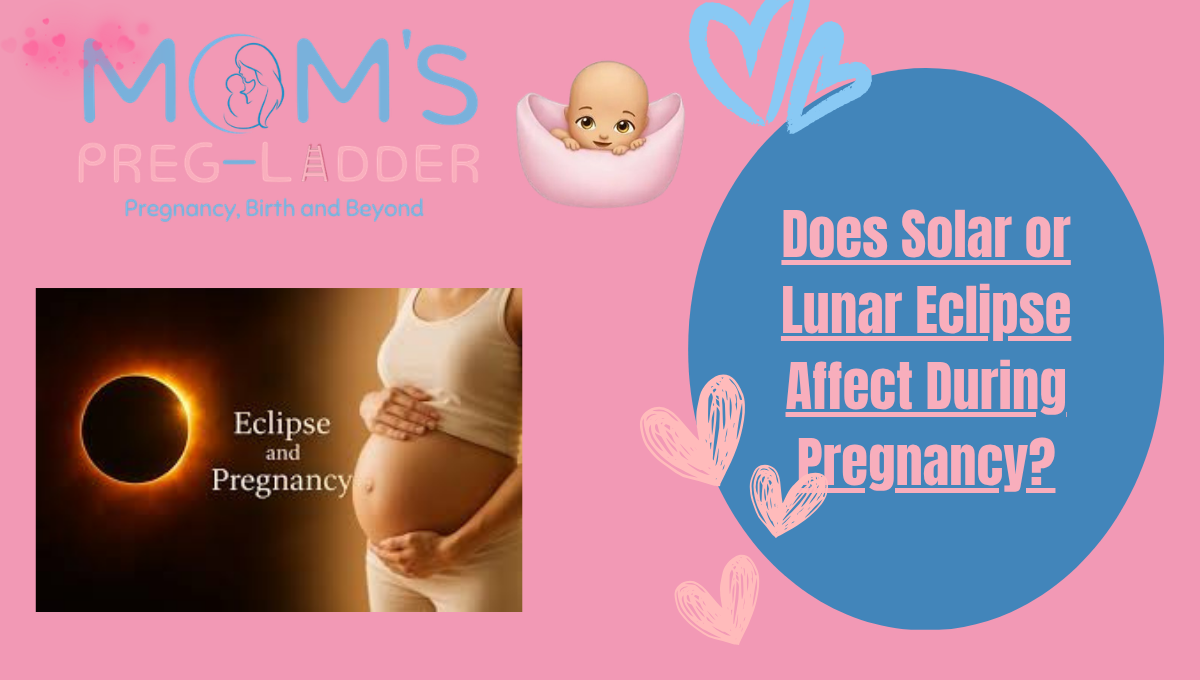
Whenever there is a solar or lunar eclipse, discussions amongst pregnant women and family members can become heated quickly. Do you need to stay inside? Do you need to avoid eating? Can the eclipse hurt your baby? If you have heard these messages, you are not alone. These myths are passed down through family lines and hold sentimental value.
Let’s talk science, not fear.
What Is a Solar Eclipse and What Is a Lunar Eclipse?
During a solar eclipse, the Moon passes between Earth and the Sun, temporarily obscuring the Sun. During a lunar eclipse, Earth passes between the Sun and the Moon, casting a shadow over the Moon.
Solar and lunar eclipses are natural phenomena. The same kinds of processes occurs during pregnancy yoga classes that occurred billions of years ago, before dinosaurs or people existed.
Here’s the important part: During an eclipse, there isn’t anything in the chemistry, biology or physics of the air, water or environment that suddenly changes. The sun does not begin emitting different radiation. The moon does not release some unknown force. The sky doesn’t turn darker because of some malevolent cosmic entity punishing us.
Does a Solar or Lunar Eclipse Affect Pregnancy? The Medical Answer
Nope. Neither eclipse is dangerous for pregnant women or their babies.
I’m not asking you to take my word for it. Leading health authorities worldwide agree. The World Health Organization (WHO) and the American College of Obstetricians and Gynecologists (ACOG) don’t list solar eclipses or lunar eclipses as potential causes of pregnancy complications, period. No legitimate scientific study has ever explained how any kind of eclipse might physically hurt a fetus.
Sun and moon eclipses don’t emit abnormal radiation. They don’t affect gravity in any way that we can measure. And they don’t affect the atmosphere. From a health perspective, pregnancy risk during solar or lunar eclipses is nil.
To quote doctor Padmini, a gynecologist interviewed by Public TV India: “ Eclipses have no influence on pregnancy or delivery and there is no need to delay deliveries or surgeries.”
Where Did These Beliefs Come From?
The worry is ancient, and it arises from multiple cultures at roughly the same time which should tell you something about our innate reactions to celestial dramas. Consider a few examples.
India: Lunar and solar eclipses were often believed to be caused by the celestial demon Rahu consuming the Sun or Moon. Pregnant women were traditionally advised to stay away from knives, fast, stay inside, and avoid seeing the eclipse. 7 safe exercises during ovulationThese taboos were meant for spiritual reasons, not health reasons.
Mexico (Ancient Aztec myth): The ancients Aztecs believed that a fearsome serpent was devouring the Sun. Pregnant women would don red undergarments or carry a piece of metal to prevent the Sun God from devouring their babies.
Norse: Vikings/Europeans believed eclipses were caused by wolves devouring the sky.
Yes, according to The Old Farmer’s Almanac, these myths range from the Chippewa all the way across the globe to Peru and China. But no matter the culture, people used what they understood to explain a terrifying, unknown occurrence.
The stories are beautiful and meaningful to their cultures. They just aren’t scientifically based.
Common Eclipse Pregnancy Myths Addressed One by One
Myth 1: The Eclipse Harms the Baby
This is the most common belief. But it is scientifically baseless. Geneticists state that birth defects or developmental problems are caused by inherited genetic defects from parents, infections, nutritional issues, exposure to medications etc. but never because of astronomical events. Aster Hospitals themselves verified the claim and said that there is no link between eclipses and fetal abnormalities.
Myth 2: You Must Fast During an Eclipse
Wait, this could actually hurt you if you do it. Dr Padmini clearly is there any side effects of magnesium during pregnancy stated prolonged fasting during an eclipse leads to low blood glucose levels which can cause serious complications for mom and baby. Did I mention dehydration? Nutrition during pregnancy is not optional. Skipping meals to be ‘spiritually safe’ will not protect you. It endangers you.
Mom’s Preg Ladder provides certified pregnancy education and prenatal coaching to moms in India. We always encourage expecting mothers to seek evidence-based care. Never fast during pregnancy without consulting your doctor, for ANY reason.
Myth 3: Going Outdoors During an Eclipse Is Dangerous
Visiting outdoors during an eclipse, either solar or lunar, is perfectly safe for pregnant women. The air doesn’t go bad. The atmosphere isn’t adversely affected. The only thing to be aware ofand this goes for everyone, pregnant woman or notis not to stare at the Sun during a solar eclipse without eye protection.
Myth 4: You Should Not Use Knives or Sharp Objects
There is a belief in South Asian traditions that this will cause insanity. There is no medical evidence to support this belief. Any sort of knife used during an eclipse, whether it be kitchen knives or scissors, pose no more danger than they would on any other day: they are only as sharp as you make them.
Myth 5: The Eclipse Causes Miscarriage or Deformities
There is zero evidence from any study, clinical trial or medical review to support this idea. The American College of Obstetricians and Gynecologists does not include eclipses as a risk factor for miscarriage. We know what causes miscarriages and eclipses are not on that list.
The One Real Risk: Eye Safety During a Solar Eclipse
Here’s one scientific warning that is legitimate, for everyone, not just pregnant women.
Looking at the Sun during a solar eclipse without certified eclipse glasses can result in solar retinopathy. According to the National Eye Institute (NEI/NIH), solar retinopathy “occurs when photo-sensitive cells in the retina are damaged by solar radiation from the Sun.” Symptoms of solar retinopathy are blurry vision, blind spots, light sensitivity, and problems distinguishing colors. Some instances of solar retinopathy have resulted in permanent vision loss.
NASA warns that solar eclipse viewers should only use “eclipse glasses that conform to the ISO 12312-2 International Standard.” Your typical sunglasses will not cut it.
Since a lunar eclipse features Earth’s satellite, which does not emit light but only reflects sunlight, there is no warning analogous to this one.
You can also make a pinhole projector to watch solar eclipses without eclipse glasses. They’re cheap and will project an image of the eclipse on a flat surface.
NEXT STEPS: If you want to safely watch a solar eclipse AND you’re pregnant, pop on a pair of ISO-approved eclipse glasses from a trusted astronomy shop. Enjoy the view, baby-safe.
What Should a Pregnant Woman Actually Do During an Eclipse?
Here is a simple, medically sound checklist:
- Eat normally. Your baby needs regular nutrition. Do not fast.
- Stay hydrated. Drink water throughout the day as you normally would.
- Protect your eyes if you plan to watch a solar eclipse. Use ISO 12312-2 certified glasses or a pinhole projector.
- Manage stress. Anxiety itself can affect maternal health. Reassure yourself that the eclipse poses no physical threat.
- Rest if you want to. Lying down or relaxing during an eclipse is completely fine and even beneficial.
- Follow your prenatal routine. Take your supplements, attend scheduled appointments, and follow your doctor’s guidance.
The team at Mom’s Preg Ladder, led by internationally certified childbirth educator Mrs. Swapnil Kaushik, teaches expectant mothers to separate cultural tradition from medical fact so that families can make calm, informed decisions at every stage of pregnancy.
Can Cultural Traditions and Science Coexist?
Yes of course.
If being indoors during an eclipse makes you comfortable and does not endanger your nutrition or health you can continue that practice. Lighting a lamp or reciting a prayer if it means something to your family is not going to cause harm either.
Where that line is drawn is: when these cultural beliefs begin to endanger your physical health by skipping meals/fastings, dehydration, etc. or limit your movement to an extreme… that is where we as medical professionals come in. Beloved family traditions do not always evolve with what we know about maternal nutrition, fetal development, and prenatal care.
One study done in 2019 through NCBI showed that pregnancy myths related to eating behavior were some of the most common worldwide and can be dangerous if practiced. Knowing which ones are not harmful and which can be hazardous is all part of taking care of yourself during pregnancy.
FAQs: Solar or Lunar Eclipse and Pregnancy
1. Is it safe to go outside during an eclipse when pregnant?
Yes, it is completely safe to go outside during a solar or lunar eclipse when pregnant. There is no radiation, air change, or biological effect that makes outdoor exposure risky during an eclipse. The only caution is avoiding direct eye contact with the Sun during a solar eclipse, which applies to everyone, not just pregnant women.
2. Can a solar or lunar eclipse cause a miscarriage?
No. There is no medical evidence that a solar or lunar eclipse causes miscarriage. Miscarriage results from chromosomal abnormalities, hormonal issues, infections, or structural problems — not from astronomical events. No medical body worldwide lists eclipses as a miscarriage risk factor.
3. Should a pregnant woman fast during an eclipse?
No. Fasting during pregnancy — for any reason without medical supervision — can lower blood glucose levels and cause dehydration, both of which carry real risks for mother and baby. Doctors recommend eating and drinking normally throughout an eclipse, just as you would on any other day.
4. Does a lunar eclipse affect the baby’s development in the womb?
No. A lunar eclipse does not affect fetal development in any way. The Moon passes into Earth’s shadow during a lunar eclipse, causing no change in radiation levels, atmospheric conditions, or any environmental factor that could influence a fetus. This belief belongs to cultural tradition, not medical fact.
5. What precautions should a pregnant woman take during a solar eclipse?
The main precaution during a solar eclipse is eye protection. Use ISO 12312-2 certified eclipse glasses if you plan to look at the Sun. Beyond that, eat your regular meals, drink water, avoid unnecessary stress, and continue your normal prenatal routine. No additional medical precautions are required for pregnancy specifically.